Wisdom or prudence can be gathered through learning, discussion and trial and error. The wise man is able to offer himself good counsel. As Seneca says:
A man with white hair and wrinkles hasn’t lived long – he has just existed long.
Your time is valuable, and it is the only thing that you cannot ever get back. Therefore, one must develop oneself. The Stoics believed that the person who has achieved perfect consistency in the operation of his rational faculties, the “wise man,” is extremely rare, yet serves as a prescriptive ideal for all. Progress toward this noble goal is both possible and vitally urgent.
Wisdom, for Stoics, can be referred to the nature of the good (virtue) and bad (vice), things that are indifferent (which neither benefit nor harm) and knowing how to act appropriately under different circumstances.
In essence, it is to understand the most important things in life, closely related to the meaning of the word “philosophy”: the love of wisdom.
Alienation from our fate is a common theme in the Stoic literature and is often marked by frustration. The Stoics practice amor fati, the love of fate, embracing whatever happens in one’s life.
To take ownership of our fate, we need to understand the indifferent nature of the external reality and to live in harmony with events beyond our control.
Following these four virtues: courage, justice, temperance and wisdom, we can avoid the trap of becoming inner slaves to our vices.
These are the virtues that the Stoics live by on a daily basis to improve their lives and the lives of people surrounding them, applying them on each and every situation that they find themselves in, ultimately it is a philosophy that teaches us the Art of Living.
Enter your e-mail to get a notification of the latest posts.
Watch The Full Video 📺
The Four Stoic Virtues | Stoicism as The Art of Living
This video focuses on the four stoic virtues: courage, justice, temperance, and wisdom. Stoicism is a philosophy most popularly associated with Seneca, Epictetus, and Marcus Aurelius.
Not to be confused with the temperance movement against the consumption of alcohol. To Stoics, temperance is moderation, or self-discipline. There must be a balance, to know what to choose, what to avoid, and what things to not do at all. We are to do the right number of things in the right way, avoiding excess through sheer willpower.
Temperance movement
If someone is provoking you to fall into vice, inciting violence, fear, hatred and so on, one is to respond thoughtfully and calculatedly instead of being reactionary and responding with one’s emotions.
Nassim Taleb defines Stoicism as:
“The domestication of your emotions, not the elimination of your emotions.”
A great way to practice this virtue is journaling. The Stoics were big on journaling, the Meditations wasn’t intended to be a book, it was the private thoughts of the Emperor of Rome.
Epictetus, who was a former slave says:
“Don’t seek for everything to happen as you wish it would, but rather wish that everything happens as it actually will—then your life will flow well.”
This of course, overlaps with courage. The first thing in life for a Stoic is to separate the things which are ‘up to us’ and things that are ‘not up to us.’ In Stoicism, this is known as the Dichotomy of Control. We are simply to accept things outside our control for what they are, focusing on what we can control, and how we respond to these things.
Enter your e-mail to get a notification of the latest posts.
Watch The Full Video 📺
The Four Stoic Virtues | Stoicism as The Art of Living
This video focuses on the four stoic virtues: courage, justice, temperance, and wisdom. Stoicism is a philosophy most popularly associated with Seneca, Epictetus, and Marcus Aurelius.
Different from the modern conception of justice in the legal sense, the Stoics refer it more to what would be moral in our dealings with others by treating others fairly and doing the right thing.
As Marcus Aurelius said: Do the right thing, the rest doesn’t matter.
Thus, it is a much more broader concept of social virtue, encompassing kindness, benevolence and goodwill toward others.
The theme of the Stoic hero or wise man who protects weaker members of his herd recurs throughout the surviving Stoic literature. He will face a lion and endure pain and injury from his claws, to defend the weaker members, because their lives instinctively matter to him, as our family and kin, ultimately to love one’s brothers and sisters.
The Stoic Hierocles recommends that we imagine our relationship as consisting of a series of concentric circles. Naturally, we are at the centre, our family and friends are in the next ring, then our community, all humanity, and eventually loving the whole of Earth. We are to draw those in the outer circles closer to the centre.
Enter your e-mail to get a notification of the latest posts.
Watch The Full Video 📺
The Four Stoic Virtues | Stoicism as The Art of Living
This video focuses on the four stoic virtues: courage, justice, temperance, and wisdom. Stoicism is a philosophy most popularly associated with Seneca, Epictetus, and Marcus Aurelius.
Stoicism is a philosophy most popularly associated with Seneca, Epictetus, and Marcus Aurelius. The Stoic school of philosophy was founded by Zeno of Citium at around 300 B.C. The supreme goal being “living in agreement with nature”, which implies both living in harmony with the universe in acceptance of its nature and laws and also living in agreement with ourselves, being consistent between our thoughts and actions. This allows us to flow through life smoothly and with inner peace, flourishing as individuals and fulfilling our own human nature, achieving eudaimonia, commonly referred to as “happiness”, although a better translation would be “fulfilment”.
One of Stoicism’s main misconceptions is that it may seem cold-hearted or unemotional. This is simply not the case. In the beginning of Marcus’ Meditations, he spends a whole chapter reminding himself of the most important things about the most important people in his life, his family and teachers.
Instead of studying philosophy in an abstract and theoretical way, Marcus shows the study of real-life examples of Stoicism being applied in daily life, as an art of living, that we can best grasp as the true meaning of the philosophy.
The modern Stoics often refer to the four cardinal virtues, recognised by Plato and Christianity, although they might date back even further than this. These virtues are courage, justice, temperance, and wisdom.
Virtue
Virtue
Virtue comes from the Latin word Virtus, which means moral excellence. The ancient Romans used this word to refer to all of the “excellent qualities of men, including physical strength, valorous conduct, and moral rectitude.” To be virtuous is excellence at being human, giving way to happiness and harmony.
Aristotle defined virtue as a point between a deficiency and an excess of a trait, the point of the greatest virtue lies not in the exact middle, but a golden mean sometimes closer to one extreme than the other, such as confidence between self-deprecation and vanity.
The Stoics held that virtue is the only real good and so is both necessary and sufficient for happiness.
These virtues can be understood as a way of living harmoniously with our own self, with other people and with external events in the world.
The Stoics use wisdom for living according to our true nature, justice for living harmoniously with other people as part of a community, and courage and temperance for living and embracing the fate that we are subject to, with respect to external events.
These virtues, of course, are all interrelated and overlap, one must for example have the necessary moral wisdom applied to one’s actions to act justly in relation to other people or be courageous enough to allow for self-restraint or moderation. The Stoics offered an analogy: just as someone is both a poet, an orator and a general, but is still one individual, so too the virtues are unified but apply to different spheres of action.
In this post we will be exploring the first virtue: Courage.
Courage
Courage is the opposite of the vice of cowardice. We are to bravely stand up for what we believe, facing daily challenges and struggles with no complaints all the while being a good person.
We are to strive for objectivity, since what causes human suffering is not the things in the world, but our beliefs about those things. We are to try to perceive the world as it is in itself, without the subjective colouring we automatically tend to ascribe to everything we experience
For the Stoics, courage also extends to the endurance of pain, discomfort and even death. One is to be unmoved by fear and willing to confront danger, pain, or intimidation.
Aulus Gellius tells the story of an unknown Stoic teacher caught in a storm at sea.
There was a terrifying storm where the boat was in danger of sinking and the crew drowning. The Stoic teacher was frightened and turned ghastly pale, but unlike the rest he wasn’t uttering any lamentations.
Stoic teacher caught in a storm at sea
After a while, the sky cleared and the sea grew calm, the Stoic teacher was approached by a man of elegant apparel who said in a bantering tone, what does this mean, sir philosopher, that when we were in danger you were afraid and turned pale, while I neither feared nor changed colour? – The teacher did not respond to his question and they parted ways.
However, when they were approaching land, the teacher was approached by someone else, who asked him what the reason for his fear was, which he refused to reveal to the man who had improperly addressed him. He answered that:
Even the mind of a wise person is bound to be disturbed, and to shrink back and grow pale for a moment, not from any idea that something bad is going to happen, but because of certain swift and unconsidered movements which forestall the proper functioning of the mind and reason.
Before long, however, the wise person refuses to give his assent to these terrifying visions of the mind, but rejects them, and sees nothing in them that ought to inspire him with fear. And that is the difference, they say, between the mind of a wise person and that of a fool, that the fool thinks that the things that initially strike the mind as harsh and terrible really are such, and then, as if they are truly to be feared, goes on to approve them by his own assent, whereas one who is wise, after being briefly and superficially affected in his colour and expression, does not give his assent, but retains the consistency and firmness of the opinion that he has always had about mental visions of this kind, namely, that such things are in no way to be feared, but arouse terror only through false appearances and empty alarms.
Enter your e-mail to get a notification of the latest posts.
Watch The Full Video 📺
The Four Stoic Virtues | Stoicism as The Art of Living
This video focuses on the four stoic virtues: courage, justice, temperance, and wisdom. Stoicism is a philosophy most popularly associated with Seneca, Epictetus, and Marcus Aurelius.
One of Albert Camus’ most famous and important works is the philosophical essay The Myth of Sisyphus. It starts off with a powerful and thought-provoking statement:
“There is but one truly serious philosophical problem and that is suicide. Judging whether life is or is not worth living amounts to answering the fundamental question of philosophy.”
Rating
⭐⭐⭐⭐⭐
Rating: 5 out of 5.
Physical suicide tends to happen without going through reflection, “one evening the person pulls the trigger or jumps.” Killing oneself is a sort of confession, that life is too much, that it is incomprehensible, or that it is not worth the trouble. Dying voluntarily implies the absence of any profound reason for living and the uselessness of suffering.
The novel presents itself through an absurdist lens. The Absurd is the conflict between the human tendency to seek inherent value and meaning in life, and the human inability to find any meaning in a purposeless, meaningless, and irrational universe, with the “unreasonable silence” of the universe in response. Trying to define this, is like water slipping through one’s fingers.
The “unreasonable” silence of the universe
However, this world in itself is not absurd, what is absurd is our relationship with the universe, which is irrational. The absurd depends as much on man as on the world. It is all that links them together. Thus, the universe and the human mind do not each separately cause the Absurd, but rather, the Absurd arises by the contradictory nature of the two existing simultaneously.
Another important aspect of this book is that it is atheistic in nature, he calls the Absurd, which we all live in to be “sin without God.”
For Camus, believing in some ready-made belief system (practically all of the world’s religion) is one of the most common ways of ‘philosophical suicide’. We believe in a hypothetical belief system, immediately alleviating us from these insecurities, at the cost of committing a sort of mental suicide by shutting down our mental faculties. There are also secular ways of committing this act, such as escaping into the world of entertainment.
However, in a world suddenly divested of illusions, man feels an alien. Without hope of a promised land. This divorce between man and his life, the actor and his setting, is properly the feeling of absurdity.
Moreover, our daily life is also absurd:
“Rising, tram, four hours in the office or factory, meal, tram four hours of work, meal, sleep and Monday, Tuesday, Wednesday, Thursday, Friday and Saturday, according to the same rhythm – this path is easily followed most of the time. But one day the ‘why‘ arises and everything begins in that weariness tinged with amazement.”
Thus, we all live in an absurd freedom, and to become lucid and conscious of it is to revolt, which is the only coherent philosophical position:
“It [Revolt] is a constant confrontation between man and his own obscurity. It is an insistence upon an impossible transparency. It challenges the world new every second. Just as danger provided man with the unique opportunity of seizing awareness, so metaphysical revolt extends awareness to the whole of experience.”
Suicide is never an option for the Absurd man, much like the leap of faith, it is acceptance at its extreme, it would be a way of going along with our absurd condemnation, by implicitly affirming that life is really intolerably absurd and that suicide is our only option.
The contrary of suicide is man condemned to death, in constant lucidity of his own absurd nature with the passionate flames of human revolt. This recognition gives life meaning, as we are truly free “to live without appeal“, as he puts it, a philosophical move to define absolutes and universals subjectively, rather than objectively.
“The only way to deal with an unfree world is to become so absolutely free that your very existence is an act of rebellion.”
He draws from the absurd three consequences: revolt, freedom and passion. Essentially, man is his own end. And he is his only end. If he aims to be something, it is in this life:
“The flames of earth are surely worth celestial perfumes.”
So, where does the title The Myth of Sisyphus come from?
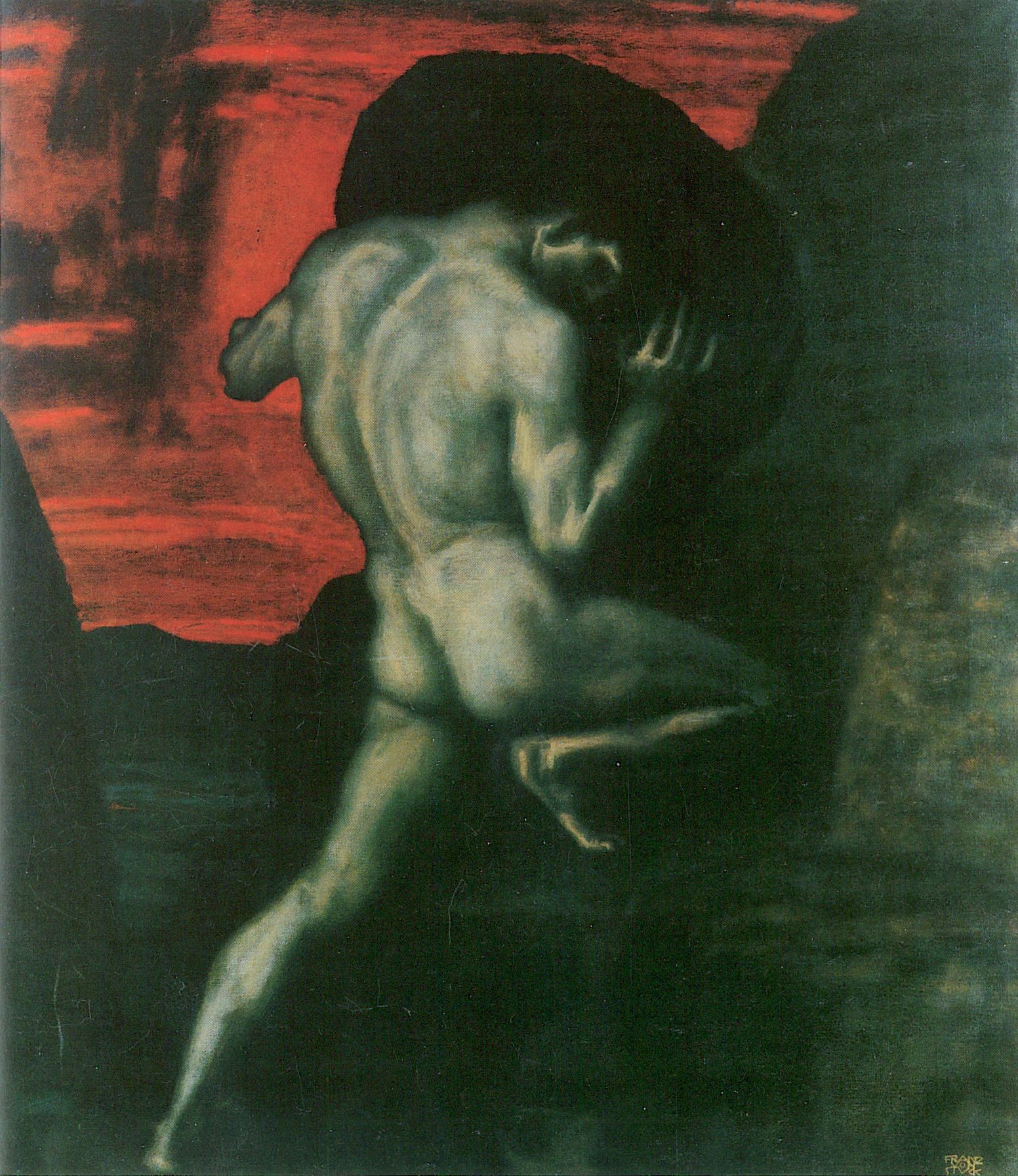
Camus associates our condemnation to the absurd to the mythological character of Sisyphus, a man condemned by the gods to a lifetime of rolling a boulder up a hill, a back-breaking and gruelling labour, only to reach the top of the hill and have the boulder inevitably roll back down to the bottom for him to start all over again, condemned to a lifetime of pain and anguish and working hard only to have his efforts be completely futile in the end.
Painting: Sisyphus – Franz von Stuck (1920)
It isn’t the repetitive and futile nature of human existence per se that makes it absurd. What really makes our human existence absurd is our consciousness of our Sisyphean condemnation when we avoid the trap of philosophical suicide.
In perhaps one of his most celebrated quotes, Camus states that:
“The struggle itself towards the heights is enough to fill a man’s heart. One must imagine Sisyphus happy.”
Camus adds that there may be a moment when Sisyphus is walking back down the hill when he is briefly free, when he is “superior to his fate. He is stronger than his rock“. Sisyphus then, is both a prisoner and rebel.
Unlike many existentialists, Camus is an earth-loving and sensitive man who loves his native home of Algeria: its sunlight, nature and the beauty of the race. At the end of the book, he writes short essays such as the Summer in Algiers where he states:
“For if there is a sin against life, it consists perhaps not so much in despairing of life as in hoping for another life and in eluding the implacable grandeur of this life.”
And Return to Tipasa, where he writes:
“In the middle of winter, I at last discovered that there was in me an invincible summer.“
And finally:
“There is thus a will to live without rejecting anything of life, which is the virtue I honor most in this world.”
📚The Book
As an Amazon Associate, I earn from qualifying purchases at no additional cost to you.
Sign up with your e-mail to get a notification of the latest posts!
Watch The Full Video 📺
Greatest Philosophers In History | Albert Camus
Camus gave rise to Absurdism. He is also considered to be an Existentialist.
This video explores his main ideas: The Absurd,Revolt and Rebellion, as well as his most notable works: The Stranger, The Myth of Sisyphus,The Rebel, The Plague, and The Fall.
He received the Nobel Prize in Literature in 1957.
“Man stands face to face with the irrational. He feels within him his longing for happiness and for reason.” – Albert Camus
1. The Absurd
The Son of Man – René Magritte
For Camus, the Absurd is the “conflict between the human tendency to seek inherent value and meaning in life, and the human inability to find any meaning in a purposeless, meaningless, and irrational universe”, with the “unreasonable silence” of the universe in response. Trying to define this, is like water slipping through one’s fingers.
However, this world in itself is not absurd, what is absurd is our relationship with the universe, which is irrational. The absurd depends as much on man as on the world. It is all that links them together.
Thus, the universe and the human mind do not each separately cause the Absurd, but rather, the Absurd arises by the contradictory nature of the two existing simultaneously.
Camus associates our condemnation to the absurd to the mythological character of Sisyphus, a man condemned by the gods to a lifetime of rolling a boulder up a hill, a back-breaking and gruelling labour, only to reach the top of the hill and have the boulder inevitably roll back down to the bottom for him to start all over again, condemned to a lifetime of pain and anguish and working hard only to have his efforts be completely futile in the end.
Sisyphus
In perhaps one of his most celebrated quotes, Camus states that:
“The struggle itself towards the heights is enough to fill a man’s heart. One must imagine Sisyphus happy.”
Happiness in the sense of living with a full acknowledgment of one’s absurd life, becoming enchanted of life, the complete opposite of nihilism.
2. Revolt
Revolt
Revolt is an essential concept for Camus, it is the maintenance of a lucid awareness of the absurdity of life. To affirm life and continue, he states that:
“One of the only coherent philosophical positions is thus revolt. It is a constant confrontation between man and his own obscurity. It is an insistence upon an impossible transparency. It challenges the world anew every second… It is not aspiration, for it is devoid of hope. That revolt is the certainty of a crushing fate, without the resignation that ought to accompany it.”
The maintenance of a lucid awareness of the absurdity of life tends to naturally stimulate “revolt”, a feeling of outrage and protest against one’s tragic condition, and a defiant refusal to be broken by it.
Camus, like Nietzsche, held his embrace of fate to be central to his philosophy and to life itself:
“a will to live without rejecting anything of life, which is the virtue I honour most in this world.”
Nietzsche
This concept of Amor Fati, to love one’s fate, is mostly linked to the Stoics. Marcus Aurelius, wrote that:
“A blazing fire makes flame and brightness out of everything that is thrown into it.”
Marcus Aurelius, Epictetus and Seneca.
And Epictetus echoed the same idea:
“Don’t seek for everything to happen as you wish it would, but rather wish that everything happens as it actually will—then your life will flow well.”
This affirmation to a more desirable existence leads to rebellion. He wrote in The Rebel, published in 1951 that:
“In order to exist, one must rebel. But rebellion must respect the limits that it discovers in itself. In contemplating the results of an active rebellion, we shall have to ask ourselves whether it remains faithful to its first noble promise or whether it forgets its purpose and plunges into a mire of tyranny or servitude. In absurdist experience, suffering is individual, but from the moment that a movement of rebellion begins, suffering is seen as a collective experience. As the experience of everyone, therefore the first step for a mind overwhelmed by the absurdity of things, is to realise the feeling of strangeness is shared by all men. That the entire human race suffers from the division between itself and the rest of the world.”
Rebellion, from this point of view, is a fabricator of universes and a metaphysical demand for unity.
Unity
However, he also talks about tyranny. Rebellion does not always lead to desirable outcomes. Camus talks about nihilistic forms of rebellion to be common, he lived in the midst of some of the worst totalitarian regimes of the 20th century: Hitler, Stalin, Mao.
He believed them to be forms of rebellion against the absurd, upon the recognition that there is no life beyond this existence. But, contrary to what he espouses, these movements expressed hatred of life and a desire, in a godless universe, to play the role of both god and devil.
He championed what he calls a genuine rebellion, which is not to implement a utopia by destructive means as nihilistic rebellions do, but which recognises the necessity of shared communal values and attempts to bring about solidarity, individual freedom and a relative harmony among human beings.
“If men cannot refer to a common value, recognised by all as existing in each one, then man is incomprehensible to man.”
He concludes with the phrase “I revolt, therefore we exist” implying the recognition of a common human condition. The argument of The Rebel was to replace ideas of revolutionary action with a concept of revolt and rebellion.
Thus, for Camus:
“The only way to deal with an unfree world is to become so absolutely free that your very existence is an act of rebellion.”
Sign up with your e-mail to get a notification of the latest posts!
Watch The Full Video 📺
Greatest Philosophers In History | Albert Camus
Camus gave rise to Absurdism. He is also considered to be an Existentialist.
This video explores his main ideas: The Absurd,Revolt and Rebellion, as well as his most notable works: The Stranger, The Myth of Sisyphus,The Rebel, The Plague, and The Fall.
He received the Nobel Prize in Literature in 1957.
Albert Camus was born in Algeria in 1913, a French colony at the time. He studied philosophy at the University of Algiers, then became a journalist.
He was born in a poor working-class family, his mother was an illiterate cleaning lady, and there were no books in his house, he lost his father when he was a few months old in the First World War. When he started going to the lycée or secondary school, he was a stranger. He came from a poor suburb and was suddenly surrounded by young boys with middle-class families.
As time passed, he soon became a well-known character in the university circles and ladies were very attracted to him. He particularly loved football, stating that: “All that I know most surely about morality and obligations I owe to football.”
Camus with his football team (in front, squatting with beret)
However, at age 17 he was struck down by tuberculosis. It interrupted his studies and his physical life. During this time, he became fascinated by theatre and acting. He organised the Theatre de l’Équipe, a young avant-garde dramatic group.
Camus married pianist and mathematician Francine, who gave birth to twins, Catherine, and Jean.
Francine and Camus with Jean and Catherine
In 1939 his play, Caligula appeared, the story of a Roman Emperor famed for his cruelty and seemingly insane behaviour. Later, he published his famous novel L’Etranger translated as The Stranger (or The Outsider), and the philosophical essay The Myth of Sisyphus.
After the occupation of France by the Germans in 1940, Camus became one of the intellectual leaders of the Resistance movement. He joined the French Resistance and became the head of the underground newspaper Combat, which he had helped found. All the students at that time read Combat, it was the newspaper that came out of the resistance and carried a daily article.
After the war, he devoted himself to writing and established an international reputation and a celebrity figure with his novels. He was awarded the Nobel Prize for Literature in 1957. At age 44, the second youngest recipient in history. He said:
“Whatever the circumstances of a writer’s life, obscure or temporarily famous, immersed in the fires of tyranny or free for a time to express himself, he can recover a sense of a living community that will justify him, but only on condition that he accepts, as much as he is able to, the two responsibilities that represent the grandeur of his profession, to serve truth and freedom.”
Camus receiving Nobel Prize in Literature (1957)
At the time Algeria was fighting for independence and there were strong differences in opinions throughout the world. He was distraught by the events there, he could think of nothing else, he did not accept the idea of independence, feeling that he had equal rights to the soil in Algeria that belong to most of his childhood.
He wrote:
“For years I wanted to live according to the morality of the majority, I forced myself to live like everyone else. I said what was necessary to say in order to bond, even when I felt separate. The upshot of all this was catastrophic, now I am wandering among the wreckage, resigned to my singularity and my disabilities and I have to rebuild the truth, having lived all my life inside a kind of lie.”
After receiving the Nobel Prize, he was no longer poor and for the first time had money to spend. He lived a frugal life, apart from dressing elegantly. He exiled himself in France, painfully cut off from Algeria, his native country, his sun. He was living in profound solitude.
Camus’ views contributed to the rise of the philosophy known as Absurdism, which has its origins in the work of Danish philosopher Søren Kierkegaard, who chose to confront the crisis that humans face with the Absurd by developing his own existentialist philosophy. Camus is also considered to be an existentialist, even though he firmly rejected the term throughout his lifetime.
Kierkegaard
He decided that his work as a writer would progress. Each stage would be marked by a play, a novel, and an essay. The first cycle was The Absurd, the second The Rebellion, and then towards the end of his life, he felt he was coming to a completely new cycle, which would be that of Love or Happiness.
However, at this time, in 1960, as he was returning back to Paris, he was killed in a road accident. In his pocket was found an unused train ticket. Also, in the wreckage were pages of handwritten manuscript, an epic novel that he had predicted would be his finest work. It was edited and published 34 years later as The First Man by Camus’ daughter Catherine, becoming an instant bestseller and helped to understand Camus’ character more deeply than any other of his works.
Car accident that killed Camus instantly
Camus teaches us, through his Absurdism, that life has inherent worth, even if it has no inherent meaning, very different from nihilism, in which nothing has any meaning. His down-to-earthiness makes one feel that he is a kind of friend guiding us on our journey of life, helping us to overcome our struggles with anxiety, depression, or suicide. He champions life, and asks us to live it, to the point of tears.
This is an introduction to Camus, in later posts we will be exploring his main ideas: The Absurd, Revolt, Rebellion, as well as his most notable works: The Stranger, The Myth of Sisyphus, The Rebel, The Plague, and The Fall.
Sign up with your e-mail to get a notification of the latest posts!
Watch The Full Video 📺
Greatest Philosophers In History | Albert Camus
Camus gave rise to Absurdism. He is also considered to be an Existentialist.
This video explores his main ideas: The Absurd,Revolt and Rebellion, as well as his most notable works: The Stranger, The Myth of Sisyphus,The Rebel, The Plague, and The Fall.
He received the Nobel Prize in Literature in 1957.
The Look is a central concept in Sartre’s phenomenology. It is the exploration of the experience of being seen. You are a subject, but if someone gazes into you for a long time, you start becoming hyper aware of yourself as an object in other people’s views.
What we think of self-consciousness is actually our consciousness of the world, for Sartre, there is no such thing as a self, an essential being that we truly are. This is merely a security blanket of an idea which he tries to get people to abandon. His whole argument is that there is no predetermined character which makes you be who you are, who you are is a function of what you do.
Sartre gives the example of a person looking through a keyhole into a bedroom. He is behaving as a subject, but the experience of being caught seeing through the keyhole immediately makes this person aware that they are a person looking at a bedroom behind a closed door, whereas before they were just looking at the scene.
Man looking through key-hole
This person has been transformed into something that was just trying to see and listen to the conversation, to a person with a nauseating feel of shame, proving that we are always under the eyes of other people. Thus, we are all objects in the eyes of others.
There is no way that people can feel entirely comfortable with each other, it is always going to be impossible to think of yourself simultaneously as someone who is going around the world acting in it and being an agent, and also to think of yourself as being an object that other people are observing.
Hell is Other People
Feeling observed
The entire social realm is based on adversarial aspects. In his book No Exit, Sartre illustrates the difficult coexistence of people, because we are unable to escape the watchful gaze of everyone around us, which alienates us and locks us in a particular kind of being, which in turn deprives us of our freedom.
“All those eyes intent on me. Devouring me. What? Only two of you? I thought there were more; many more. So, this is hell. I’d never have believed it. You remember all we were told about the torture-chambers, the fire and brimstone, the “burning marl.” Old wives’ tales! There’s no need for red-hot pokers. HELL IS OTHER PEOPLE!”
Why Sartre is worth reading
Sartre’s physical condition deteriorated, in part because of his workaholism, but also because he was a notorious chain smoker. He died in 1980 from swelling of the lung. Over 50,000 people took to the streets of Paris to follow his coffin and millions watched on television. No philosopher had ever had a bigger following.
Sartre’s funeral
He was a philosopher who thought against himself, against everything given to him by society and education, he spent his life testing the limits of traditional thinking. The fact that life is meaningless gives us the opportunity to give it a meaning. It is precisely because it doesn’t have a meaning in advance that we are justified in creating one.
In a world with increasing anguish and despair, Sartre teaches us that we are in control of our lives, that we are allowed to build it the way we want with our own values. Life is your own work of art.
📚 Book recommendations
As an Amazon Associate, I earn from qualifying purchases at no additional cost to you.
📺Watch The Full Video!🧠
Greatest Philosophers In History | Jean Paul Sartre
This video explores Sartre’s main ideas including: Nausea, the Absurdity of the World, Existence precedes Essence, Freedom, Bad Faith, The Look and Hell is Other People, among others.
Sartre´s masterwork and major philosophical work of his life is Being and Nothingness, which became the core of Existentialism. He speaks of consciousness, bad faith, the existence of “nothingness”, free will and authenticity. The idea that individuals can always choose their own actions, even in situations which appear to enslave them.
He begins with the origin of negation, the empty nothingness or opposite of being. Our conscious existence introduces the idea of nothingness into the world. What this means is that we are able to conjure up things that aren’t physically visible to us.
For example, you might see your bed because its right in front of you, but you can also not see a pyramid, you can imagine it being there, and thus your experience of the current room is altered and structured around the fact that there is not a pyramid in it.
Sartre believes consciousness involves making ongoing distinctions between things and yourself. He explains that making these distinctions that make things appear as they do in our experience, also involves their continuing to not appear to be other things. It is a process of negation.
A table continues to be a table, it is not an animal, an automobile, or an abstract formula. In other words, things are what they are by their continuing to not be what they are not.
Thus, perception is a negative process and consciousness affects it by nihilating, to encase in a shell of non-being.
The Being For-itself and The Being In-itself
The theory of nothingness is central to Sartre’s philosophy. He distinguishes between two kinds of being: consciousness or what he calls the BeingFor-Itself, which is the source of all meaning. And on the other hand, a mode of existence that simply is, which is not conscious and is relevant only to inanimate objects, the Being In-Itself.
One of the problems of human existence for Sartre is the desire to attain Being-In-Itself, which he describes as the desire to be God, a longing for full control over one’s destiny and for absolute identity, only attainable by achieving full control over the destiny of all existence.
The world is meaningful to us because we, the For-Itself, give meaning to the In-Itself. The For-Itself uses the world to try to give itself some kind of definition, but it is pure nothingness.
Sartre doesn’t believe you can define humanity, whatever we are is so free that we can constantly redefine whatever we are. Nothing could ever become necessary for us. Therefore, we are a kind of nullity. But we must have some kind of content, we need to become, what he calls an In-Itself For-Itself. That is, we need to become conscious of having some meaning and content.
All of our activity is understood by trying to cover up our nothingness and delude ourselves into thinking that we have an identity, some kind of content and meaning in our lives. But since we really don’t and can’t have it because we are pure freedom and nothingness, we are a futile passion or in despair. So, we are constantly in bad faith, we are the kind of being that needs something that we can’t have.
The Being For-Others
Giant Crowd Painting by Emily Grenader
In addition, he later adds the Being For-Others, which englobes the whole of society. He states that many relationships are created by people’s attraction not to another person, but rather how that person makes them feel about themselves by how they look at them. Whenever Sartre thought about what other people were thinking when they were looking at him is fundamental to his existence and to all his writing.
📚 Book recommendations
As an Amazon Associate, I earn from qualifying purchases at no additional cost to you.
📺Watch The Full Video!🧠
Greatest Philosophers In History | Jean Paul Sartre
This video explores Sartre’s main ideas including: Nausea, the Absurdity of the World, Existence precedes Essence, Freedom, Bad Faith, The Look and Hell is Other People, among others.
A common trap that people fall into is what Sartre calls Bad Faith, a dominant theme of his work. Bad faith is a way of denying the fundamental nature of our freedom and responsibility, it is a way of making excuses for ourselves.
We accept something as true that really isn’t that convincing to us, but because it is convenient and easy for us to believe in.
Sartre talks about a hypothetical waiter, he does not like his job, he goes to work day after day and does not feel fulfilled, but when he thinks of applying to a different job or asks himself the difficult questions that would come along with that sort of life choice, he convinces himself that it’d be better to just to remain a waiter.
For Sartre, this is nonsense, it is Bad Faith. We are free individuals that can choose the meaning of our life. We convince ourselves that we actually don’t have a choice: we need the money, to pay the bills, feed our family, and so on. And that being unhappy at the current job is just how life is.
Sartre would say that it is entirely self-imposed, it is self-deception. It is something that people do to avoid making difficult life decisions, desperately trying to avoid temporary discomfort in the present moment, which comes from the ability to choose and be free, telling oneself excuses. We put ourselves in long-term agony, in an attempt to avoid short-term discomfort.
📚 Book recommendations
As an Amazon Associate, I earn from qualifying purchases at no additional cost to you.
📺Watch The Full Video!🧠
Greatest Philosophers In History | Jean Paul Sartre
This video explores Sartre’s main ideas including: Nausea, the Absurdity of the World, Existence precedes Essence, Freedom, Bad Faith, The Look and Hell is Other People, among others.